

The 2 Mistakes Everyone Makes When Pricing Land (And How We Avoid Them)
Every Friday I get on a call with investors, realtors, and people who are just trying to figure out how this whole infill development thing works, and I break down the most interesting deal I found that week. This week I wanted to slow down and cover something I run into constantly — probably weekly, if not multiple times a month — because it costs sellers, realtors, and land flippers real money.
Here it is: most people have no idea what land is actually worth, and almost nobody understands what it costs to develop it.
Not a dig on anyone. It's just the reality of this business.
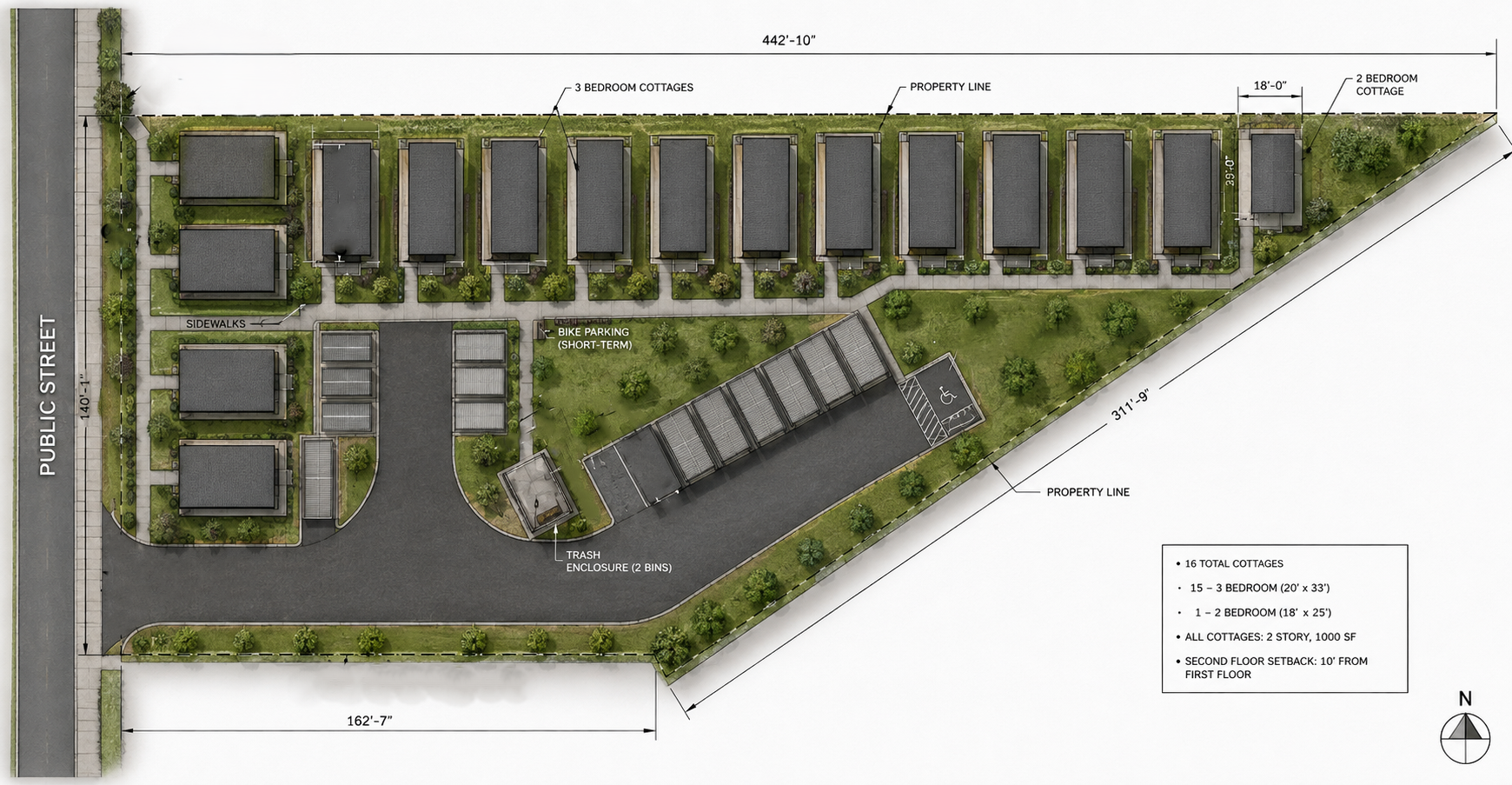
16-Unit Boise Cottage Development
Mistake #1: Nobody Actually Knows What Land Is Worth
I'm not knocking realtors here — I work with great ones all the time, and I have the utmost respect for what they do. But 90-95% of realtors have never done a land deal and don't understand development. That's not a criticism, it's just math. There aren't enough land deals happening in most markets for anyone to build real expertise unless they specialize in it.
So here's what usually happens. A seller looks up their zoning, maybe calls the city, and finds out they can build five homes on their lot. Great. Now they see dollar signs. They remember a lot down the street — or worse, in a totally different neighborhood — that sold for $150,000. So they do the math: $150,000 times five lots equals their $300,000 house is now magically worth $750,000.
I ask sellers this all the time: "When you bought the property, did you pay extra because it was on a larger lot?" The answer is almost always no. They never budgeted for what it actually costs to turn raw land into a buildable lot.
And here's the thing about land comps — I basically don't use them. About 95% of the time, when I'm figuring out if a deal is a deal, I'm not pulling up what other properties sold for. Because it genuinely doesn't matter to me if an entitled 12-unit project sold for a certain price in another neighborhood. That property was probably already entitled — meaning someone already did the work and removed the risk. A fully entitled property will sell for more than raw land every single day of the week. If you're comparing an entitled deal to raw dirt, you're not comparing apples to apples. You're not even in the same aisle.
Mistake #2: Nobody Knows What Development Actually Costs
Even people who've been around real estate for years usually have no idea what has to physically go into the ground before you can build anything.
A classic example: someone looks at a property with an existing home and assumes they can just tie into the existing sewer line. Makes sense on paper. But more often than not, that 50-year-old 4-inch sewer line doesn't meet today's standards and can't handle additional units — so you're putting in a brand new sewer main. Same story with roads. If the road out front doesn't meet current standards, the highway district is going to make you widen it and add public sidewalks, and the city will make you add internal ones. There are about a dozen different agencies you have to satisfy, and each one adds cost most people never budgeted for.
If you want a rough back-of-napkin number, I tell people to think $60,000-$70,000 per lot for infrastructure as a rough median — knowing it can range anywhere from $20,000 to $100,000 or more depending on lot size, unit count, and what the property actually needs.
This Week's Deal: Turning a Mixed-Use Property Into 16 Cottages
This week's Deal of the Week is a property I actually passed on the first time I saw it, because it's zoned MX1 (mixed-use), and mixed-use zoning in Boise doesn't allow for cottage villages, and the lot is limited for other development. But when I pulled up the city's future land use map, this parcel is designated high density, and it's sitting next to R-2 zoned property on two sides. Mixed-use doesn't really fit the neighborhood — there's no reason for commercial here, it's a dead-end street, and there's already an apartment complex nearby.
That told me this property has a strong case for a rezone to R-2. I'd put that confidence around 90%, and once Planning and Zoning approves a rezone, City Council rarely overturns it — so realistically we're talking a very high level of confidence overall.
The plan: 16 detached cottages on a condo plat, built in two phases so the existing four rental homes keep generating income while we work through entitlements. Investor profit lands around $475,000 on roughly $325,000 of capital — and because you wouldn’t close until we're through the rezone, we're not taking that entitlement risk before it's removed.
Why We Back Every Deal With a Profit Guarantee
Once we're through our 200-point due diligence checklist and we hand you a one-page underwriting worksheet with the numbers, we back it up with a profit guarantee. If the deal doesn't hit the number we projected, we'll refund you the difference — up to $20,000 per unit. On a 16-unit deal, that's up to a $200,000 buffer under the number we promised.
Our goal is always to under-promise and over-deliver. There's no such thing as a zero-risk deal in real estate, but we're putting our own capital behind these projections because we believe in them.
Want to See These Deals Live?
Every Friday around noon, I send out our Deal of the Week email with a one-page deal sheet — capital stack, projected returns, everything. I also host a live Zoom call every Friday where I walk through it and answer questions in real time.
[Sign up for the Friday call and email list here →]https://zoom.us/meeting/register/xAWM-Ep8Raey8XwGWTrxtw
Want to watch the full replay of this live call? Watch the replay here: https://youtu.be/0jR9qdZMSYg
— Zach
